
Video companion
After PBS Infinite Series: period-finding and the quantum threat to PKI
PBS Infinite Series walks through the mathematics behind Shor's algorithm — period-finding and the quantum Fourier transform — without assuming a quantum physics background.
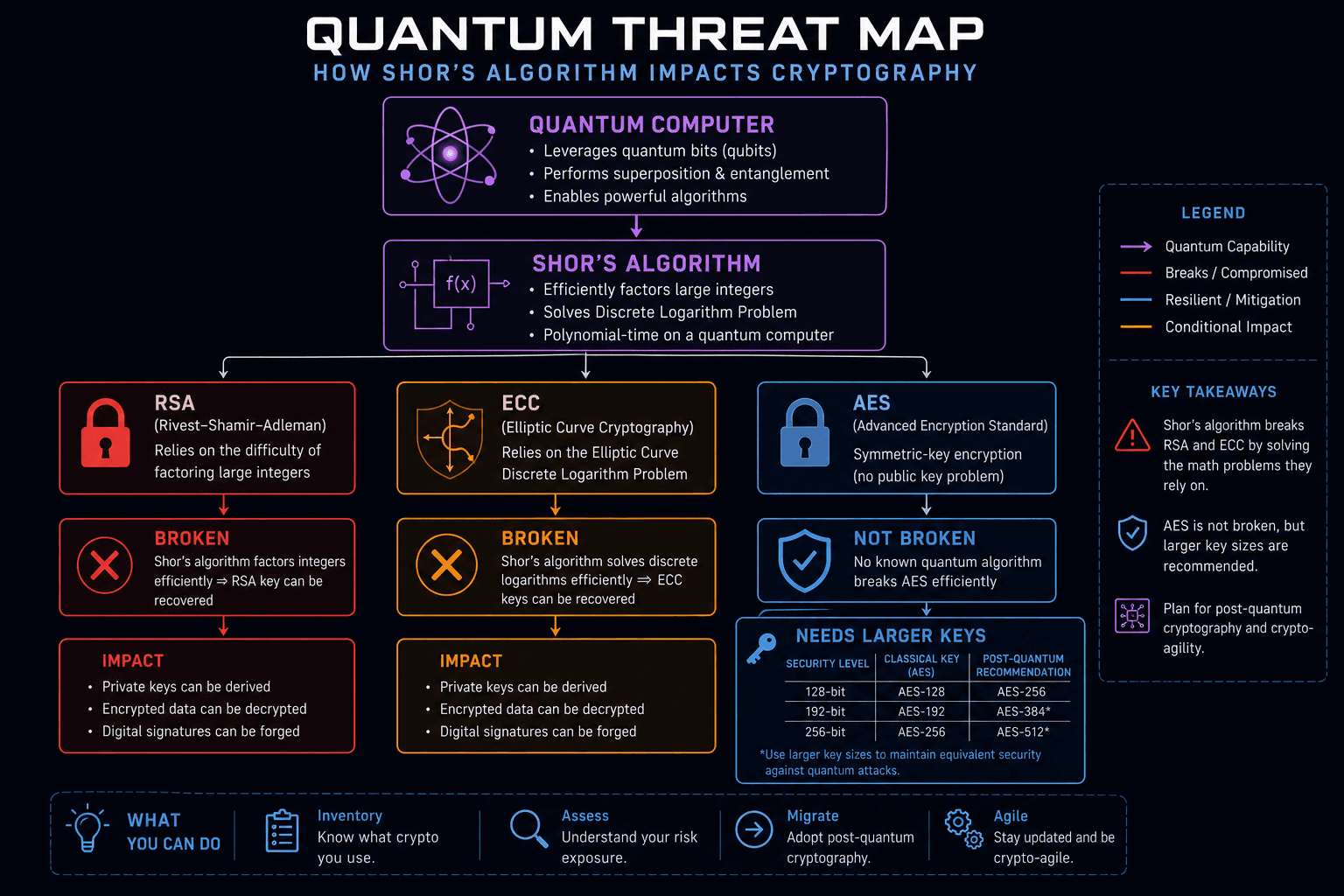
What the video gets right
The core insight: factoring (N = p \times q) reduces to finding the period (r) of (a^x \mod N). Classical computers struggle with this; a quantum computer uses superposition and the quantum Fourier transform to extract the period efficiently.
That is why RSA and elliptic-curve cryptography — both built on hard number-theoretic problems — fall to Shor's. Pair this video with minutephysics' Shor's explainer for a two-part foundation.
NIST's overview explains why lattice-based replacements (ML-KEM, ML-DSA) resist known quantum attacks.
What it does not cover
Period-finding is elegant mathematics; your audit committee wants asset lists. Engineers need to know where RSA and ECDH appear: TLS handshakes, code signing, email (S/MIME), VPN, and JWKS endpoints for OIDC tokens.
This quarter
- Complete both Shor explainers (minutephysics + PBS) and confirm you can explain the threat without slides.
- Extend inventory beyond web TLS to JWKS, STARTTLS, and SSH host keys.
- Export a CBOM and crosswalk to NIST IR 8547 migration phases.
Continue on the Q-Day hub: What is Q-Day? guide
References & further reading
Authoritative primary sources cited in this article. Summaries are our own — follow links for full context.
Last verified 2026-06-21
- Hacking at Quantum Speed with Shor's AlgorithmPBS Infinite Series (YouTube) · 2017Deeper dive into the number theory and quantum Fourier transform behind Shor's algorithm.
- How Quantum Computers Break Encryption | Shor's Algorithm Explainedminutephysics (YouTube) · 2019Accessible explainer on Shor's algorithm, period-finding, and why RSA breaks on a large quantum computer.
- Shor's Algorithm: A Quantum Threat to Modern CryptographyPostQuantum.com · 2024Written explainer for security professionals — RSA, ECC, Shor's steps, and PQC migration strategies.
- What Is Post-Quantum Cryptography?NIST · 2024Official overview of NIST's PQC project, finalized standards, and the harvest-now-decrypt-later threat model.
See your exposure with evidence
Run a live PQC inventory scan, export a CBOM, and verify signed reports independently.