
Avalon - A classical-quantum programming language
Quantum computing is progressing slowly but surely. And as it progresses, tools are going to be needed to program quantum computers.
Avalon is a programming language aimed at a specific class of quantum computers called classical-quantum hybrid quantum computers. A hybrid classical-quantum computer has the property of having a classical computer driving (telling) the quantum computer what to do. These computers are being built by IBM and Rigetti and Avalon seeks to target both, starting with Rigetti.
Currently, all you will get is an interpreter to start prototyping on your own system while I'm working on generating QUIL (Rigetti) code.
The documentation can be found at Read The Docs and please do look in the tests/integration folder for sample code to run.
Why Avalon
Quantum computing is progressing and it needs tools among which programming languages are going to play a vital role. Yes, there exists other programming languages that target hybrid classical-quantum computers but I have found them to be lacking in abstractions and many even exposing hardware primitives making them unfriendly to the novice developer.
Even more important, as we approach the NISQ era, compilers are going to play a vital role in the optimisation of quantum programs when we have little to no error correction built into the hardware. It is the hope that Avalon will come out as the leading programming language for writing programs meant for near-term quantum computers.
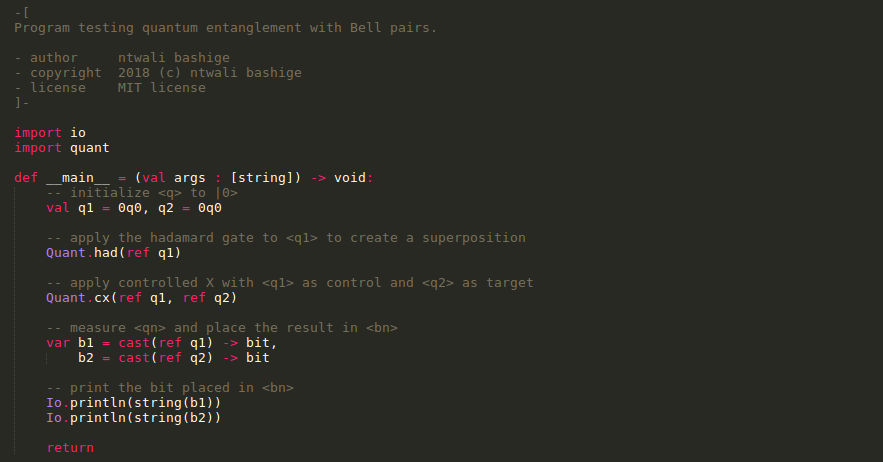
What it looks like
State of the project
Currently, the classical part is close to 90% finished (excluding known bugs). The missing feature is pointer types. Getters and setters are being reworked into a better form. Otherwise the rest works as intended.
The quantum part, 1-Qubit data types and gates that act on them are implemented and can be tested. The 2-Qubits, 4-Qubits and 8-Qubits data types are implemented but gates that operate on them are still missing but upcoming.
Show me the code
Please find below the teleportation code found in tests/integration/quantum/teleportation.avl reproduced for your copy-paste-run pleasure.
import io
import quant

def __main__ = (val args : [string]) -> void:
    -- initialize quantum variables
    val source = 0q1,
        destination = 0q0,
        ancilla = 0q0

    -- create an entanglement between the destination and the ancilla
    Quant.had(ref destination)
    Quant.cx(ref destination, ref ancilla)

    -- perform the teleportation
    Quant.cx(ref source, ref ancilla)
    Quant.had(ref source)

    -- measure the source and the ancilla
    var source_bit = cast(ref source) -> bit,
        ancilla_bit = cast(ref ancilla) -> bit

    -- perform phase correction on the destination
    if source_bit == 0b1:
        Quant.pz(ref destination)
    if ancilla_bit == 0b1:
        Quant.px(ref destination)

    -- measure and print the destination which should contain <0q1>
    var destination_bit = cast(ref destination) -> bit
    Io.println(string(destination_bit))

    return
Installation
Currently, installation can only happen from source and the code has only been tested on a Linux system.
Installation directions can be found at installing Avalon.
Documentation
Documentation is currently being written as the language evolves.
You can find the documentation at Read The Docs.
Contributing
Thank you for considering it. Please see the contribution guidelines for help on contributing.
Contact
You can reach me at nbashige@gmail.com
License
This code is licensed under the MIT license. Please see the LICENSE file for the terms.
Acknowledgement
Development of Avalon is being supported by the Unitary Fund grant. My thanks to Will J. Zeng for running the program.
Copyright
Copyright (c) 2018 Ntwali Bashige Toussaint
In case you found code that is yours and I failed to give attribution or I am claiming copyright of the code, please do email me to resolve the issue.