
Qiskit Nature
Qiskit Nature is an open-source framework which supports solving quantum mechanical natural science problems using quantum computing algorithms. This includes finding ground and excited states of electronic and vibrational structure problems, measuring the dipole moments of molecular systems, solving the Ising and Fermi-Hubbard models on lattices, and much more.
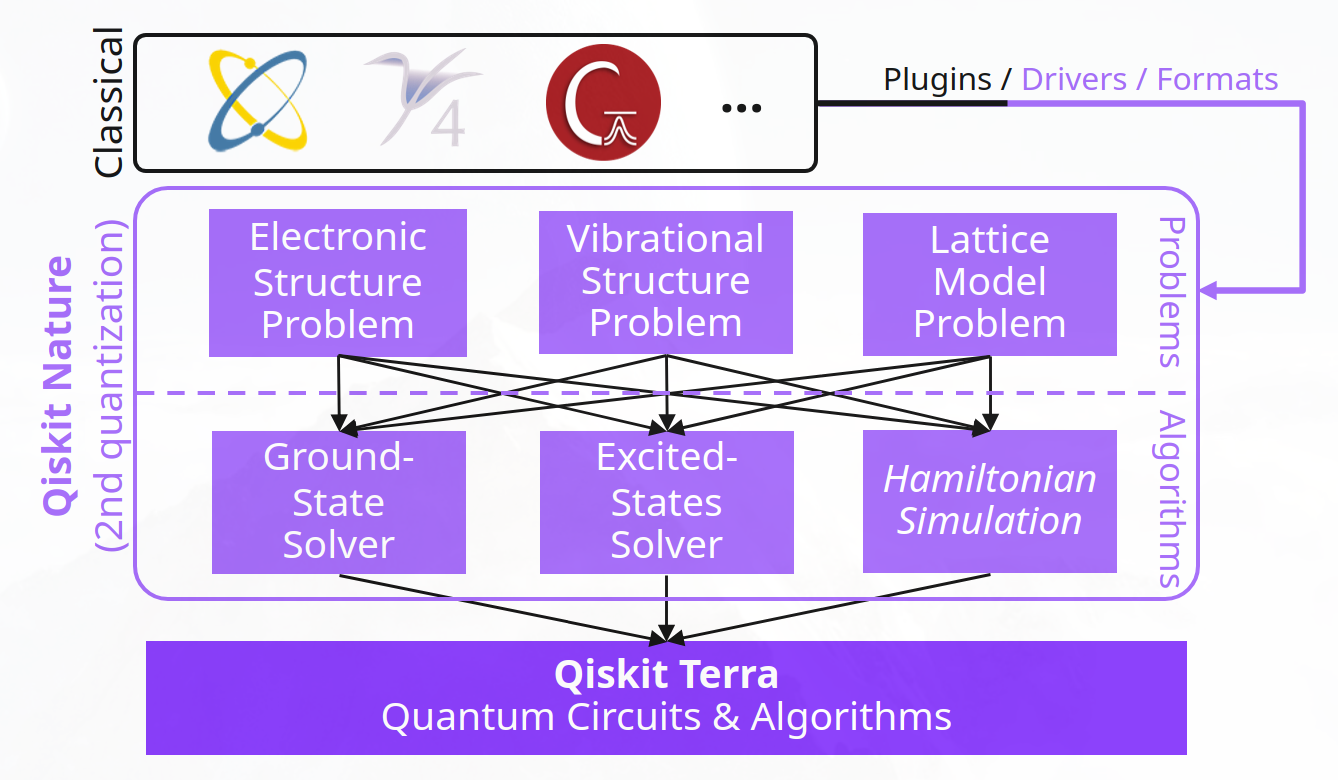
The code comprises various modules revolving around:
- data loading from chemistry drivers or file formats
- second-quantized operator construction and manipulation
- translating from the second-quantized to the qubit space
- a quantum circuit library of natural science targeted ansatze
- natural science specific algorithms and utilities to make the use of algorithms from Qiskit Algorithms easier
- and much more
Installation
We encourage installing Qiskit Nature via the pip tool (a python package manager).
pip install qiskit-nature
pip will handle all dependencies automatically and you will always install the latest (and well-tested) version.
If you want to work on the very latest work-in-progress versions, either to try features ahead of their official release or if you want to contribute to Qiskit Nature, then you can install from source. To do this follow the instructions in the documentation.
Optional Installs
To run chemistry experiments using Qiskit Nature, it is recommended that you install a classical computation chemistry software program/library interfaced by Qiskit. Several, as listed below, are supported, and while logic to interface these programs is supplied by Qiskit Nature via the above pip installation, the dependent programs/libraries themselves need to be installed separately.
- Gaussian 16™, a commercial chemistry program
- PSI4, a chemistry program that exposes a Python interface allowing for accessing internal objects
- PySCF, an open-source Python chemistry program
The above codes can be used in a very limited fashion through Qiskit Nature. While this is useful for getting started and testing purposes, a better experience can be had in the reversed order of responsibility. That is, in a setup where the classical code runs the Qiskit Nature components. Such an integration currently exists for the following packages:
- PySCF via qiskit-nature-pyscf
If you are interested in using Psi4, we are actively looking for help to get started on a similar integration in qiskit-nature-psi4.
Additionally, you may find the following optional dependencies useful:
- sparse, a library for sparse multi-dimensional arrays. When installed, Qiskit Nature can leverage this to reduce the memory requirements of your calculations.
- opt_einsum, a tensor contraction order optimizer for
np.einsum.
Creating Your First Chemistry Programming Experiment in Qiskit
Check our getting started page for a first example on how to use Qiskit Nature.
Further examples
Learning path notebooks may be found in the Nature Tutorials section of the documentation and are a great place to start.
Contribution Guidelines
If you'd like to contribute to Qiskit, please take a look at our contribution guidelines. This project adheres to Qiskit's code of conduct. By participating, you are expected to uphold this code.
We use GitHub issues for tracking requests and bugs. Please join the Qiskit Slack community for discussion and simple questions. For questions that are more suited for a forum, we use the Qiskit tag in Stack Overflow.
Authors and Citation
Qiskit Nature was inspired, authored and brought about by the collective work of a team of researchers. Qiskit Nature continues to grow with the help and work of many people, who contribute to the project at different levels. If you use Qiskit Nature, please cite the following references:
- Qiskit, as per the provided BibTeX file.
- Qiskit Nature, as per https://doi.org/10.5281/zenodo.7828767
License
This project uses the Apache License 2.0.
However there is some code that is included under other licensing as follows:
- The Gaussian 16 driver in
qiskit-naturecontains work licensed under the Gaussian Open-Source Public License.